





In Moby Dick, Patrick Hardy reimagines one of literature’s most overdetermined icons—the white whale—not as a monster to be conquered or a myth to be decoded, but as a presence that simply exists: enormous, watchful, and strangely calm within a sea that feels less like nature than like a living system of patterns.
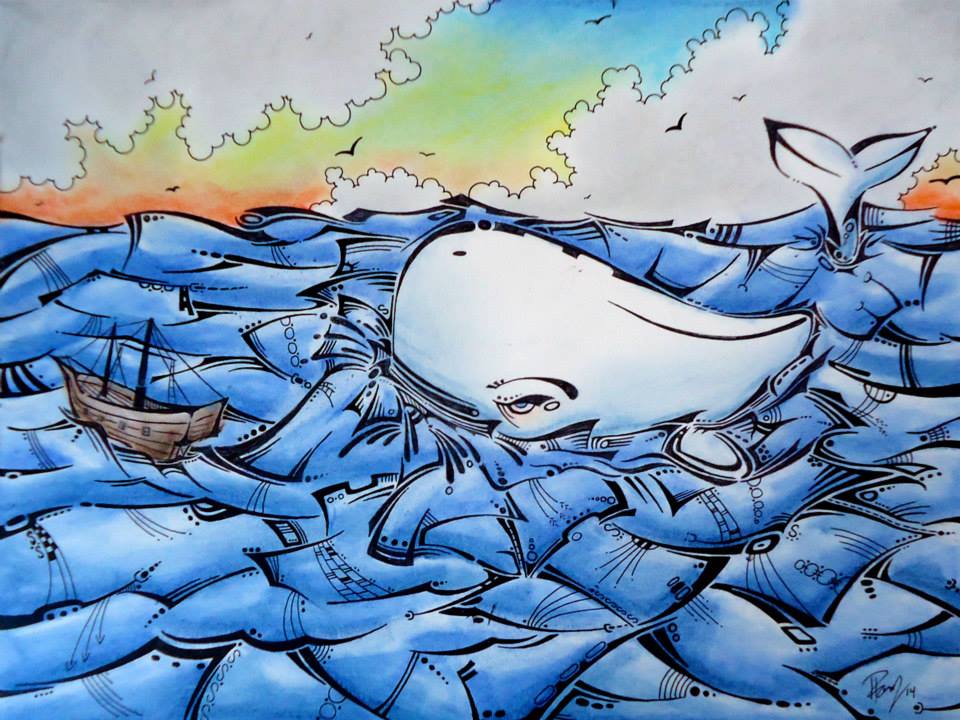
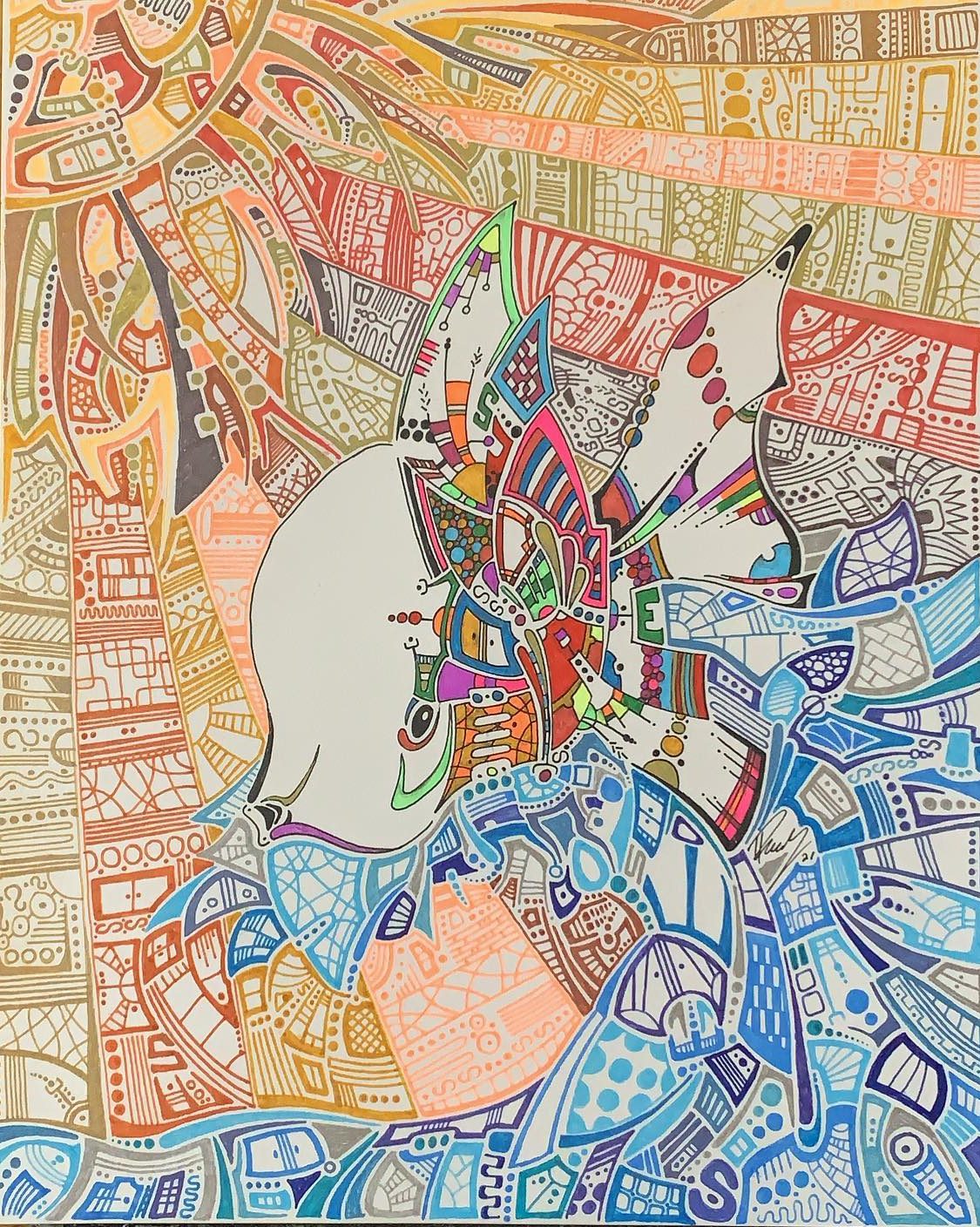
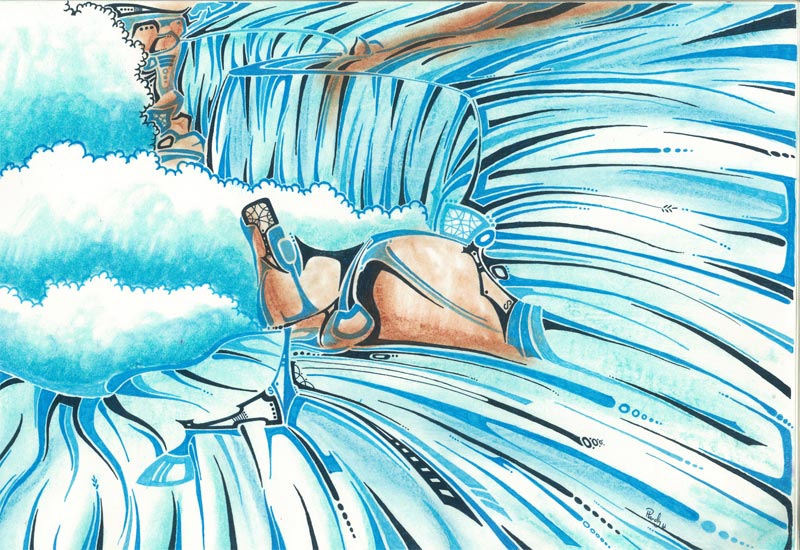
At first glance, the work reads as playful: a cartoon-inflected whale surges through blue waves under a sky washed in sunset gradients. But as the eye settles, the surface reveals itself to be densely articulated, stitched with graphic marks—dots, seams, hatch lines, and mechanical curves—that transform the ocean into something engineered. The water doesn’t behave like water. It behaves like design. The waves fold into one another in overlapping shards, as if the sea has been rendered in panels or plates—an ocean constructed rather than observed.
This is where the piece begins to quietly outsmart the viewer. The whale’s body is rendered with remarkable restraint: the bright whiteness acts like a visual silence amid the surrounding noise of blue. It is a void, a calm interruption. In a composition dominated by motion, the whale becomes paradoxically still. Its eye—half-lidded, slightly weary—grounds the entire image with a subtle emotional register. The expression suggests intelligence, even judgment, but not malice. It reads as ancient, familiar with human drama, and completely uninterested in participating in it.
Hardy’s choice to place the small ship at the left edge is crucial. The vessel is almost secondary, swallowed by waves that feel too stylized to be purely threatening, yet too relentless to be decorative. The scale difference carries the obvious symbolic weight—human ambition dwarfed by nature—but here that theme arrives without melodrama. The ship looks like a toy, an artifact from another narrative tradition, while the whale feels contemporary, like a character redesigned for an era that distrusts heroism.
The sky above, with its soft rainbow gradients and looping cartoon clouds, introduces an unexpected tenderness. It’s a horizon that belongs more to imagination than realism, and the birds are reduced to minimal marks—just enough to suggest distance and open air. This upper band of color acts like a release valve: it prevents the image from becoming heavy, and it subtly frames the entire scene as mythic memory rather than direct confrontation. It’s not a scene of violence. It’s a scene of inevitability.
What distinguishes Moby Dick is the way it merges visual languages. There’s a clear lineage of street-art illustration and graphic design in the linework—confident, rhythmic, and full of emblematic patterning—while the watercolor-like washes (particularly in the ocean) introduce softness and atmosphere. The result is a hybrid: the sea is both fluid and structured, both expressive and diagrammatic. It’s as if the ocean has been mapped by someone who loves it too much to depict it plainly.
And then there is the whale itself: a form so simplified it becomes archetypal, yet so well-placed it feels emotionally complex. Hardy’s whale is not the terror of the deep; it is the deep. It carries a kind of visual authority that makes the ship look not brave, but naïve. The composition suggests that the real subject is not pursuit, but perception—the way humans project meaning onto what they cannot contain.
In the end, Moby Dick is less about the famous novel than about the feeling the novel has left behind in culture: the whale as symbol, the sea as subconscious, the ship as obsession. But Hardy updates the myth with a tone that feels distinctively modern—less grand, more lucid. This is a work that understands that legends survive not because they are true, but because they can be redrawn.
Here, the whale is redrawn beautifully: not as a target, but as a force of quiet magnitude—moving through a world of patterns, unbothered by the fragile, drifting stories that humans insist on calling destiny.