










The Sacred and the Synthetic: A Critical Analysis of The Ring
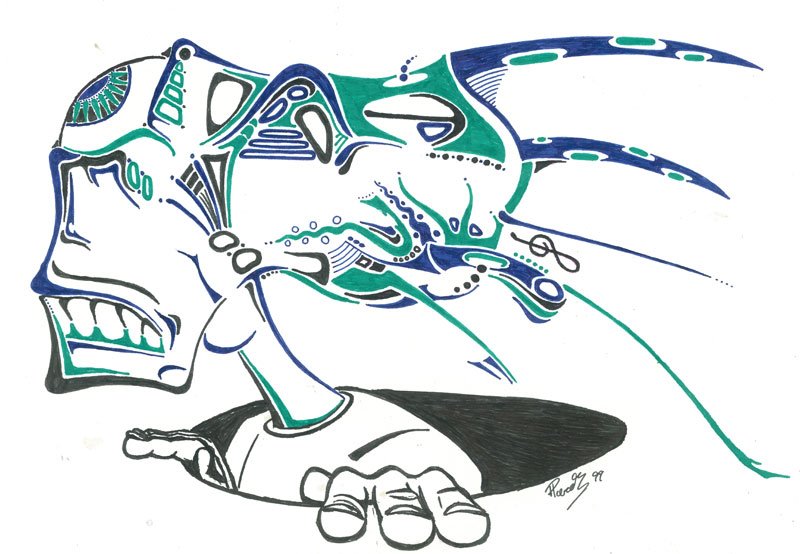
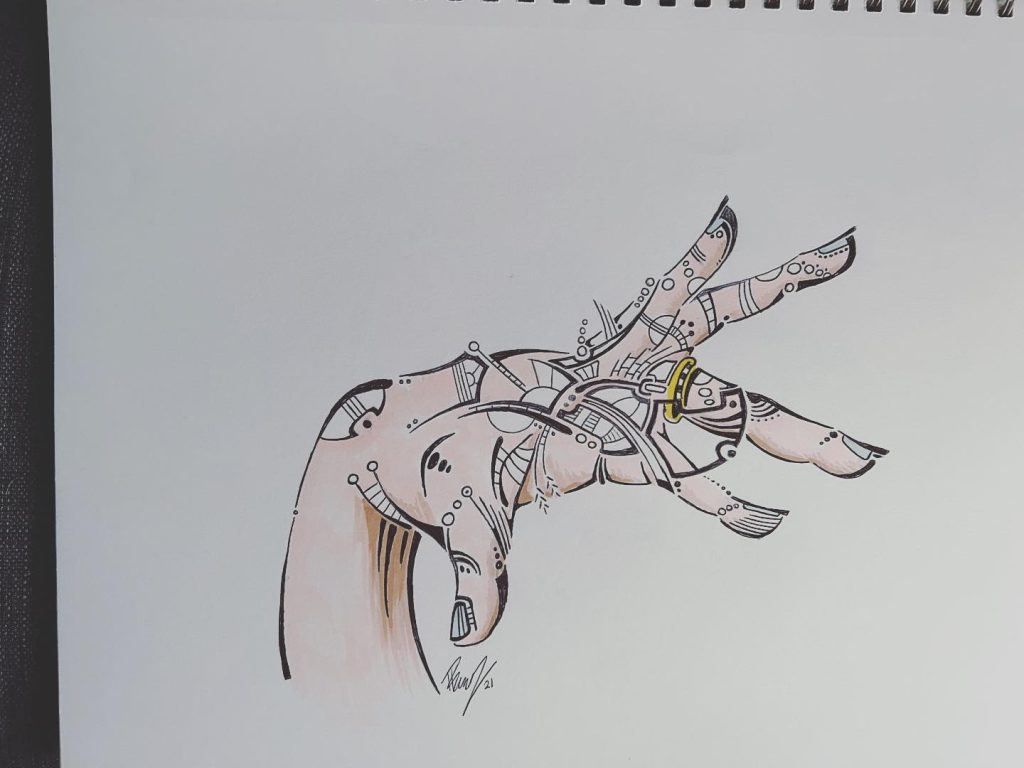
In an era increasingly dominated by sterile digital rendering, The Ring offers a refreshing and deeply compelling return to the tactile intimacy of ink on paper. At first glance, the piece presents itself as a figurative study of a human hand—a subject with a long, storied tradition in art history, from Leonardo da Vinci’s anatomical sketches to Egon Schiele’s expressive, contorted fingers. However, the artist swiftly departs from pure naturalism, transforming a simple gesture into a complex meditation on energy, technology, and adornment.
The defining characteristic of The Ring is its intricate, almost mechanical linework. The artist maps a network of cybernetic and organic patterns directly onto the skin: clusters of fine dots, concentric arches, and circuit-like pathways trace the contour of every joint and muscle. This graphic language creates a fascinating duality. The hand feels simultaneously ancient—evoking traditional henna or tribal body art—and futuristic, resembling an intricate biomechanical schematic.
Color in this drawing is deployed with remarkable restraint and surgical precision. The base layer—a warm, translucent wash of skin tone—gives the form a soft, organic vitality that contrasts sharply with the uncompromising black ink. But it is the title element that truly dictates the composition. Positioned at the juncture of the palm, a loop of vibrant, golden yellow serves as the visual and thematic anchor of the piece.
This halo-like ring is far more than a decorative accessory; it acts as an energy source. The surrounding black linework seems to emanate from or power into this single focal point, pulling the viewer’s eye straight into the center of the palm. By isolating this single pop of color, the artist elevates the ring from a mere object into a symbolic nucleus—a point of connection, power, or transformation.
Technically, the artist demonstrates impressive line control. The varying weights of the ink, from bold outer contours to delicate, microscopic detailing on the fingertips, give the piece a dynamic rhythm. The decision to leave the background completely blank emphasizes the iconic quality of the gesture, allowing the hand to float like a sacred artifact or a floating diagram.
The Ring is a captivating fusion of form and concept. It reimagines the human body not as static flesh, but as a living transmitter of energy, bound by geometry and ignited by a single spark of gold. It is a subtle, striking, and thoroughly memorable work that invites the viewer to look closer at the delicate machinery of the human hand.