


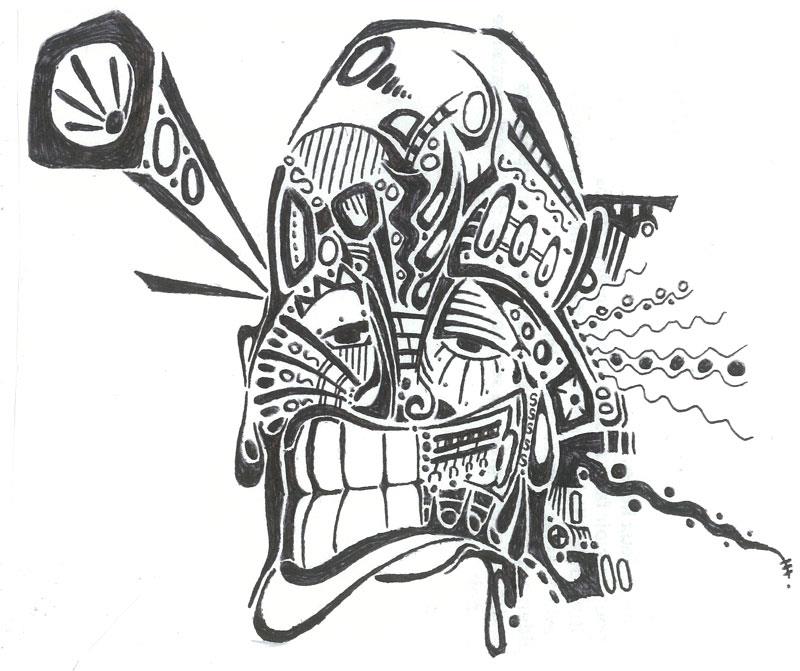
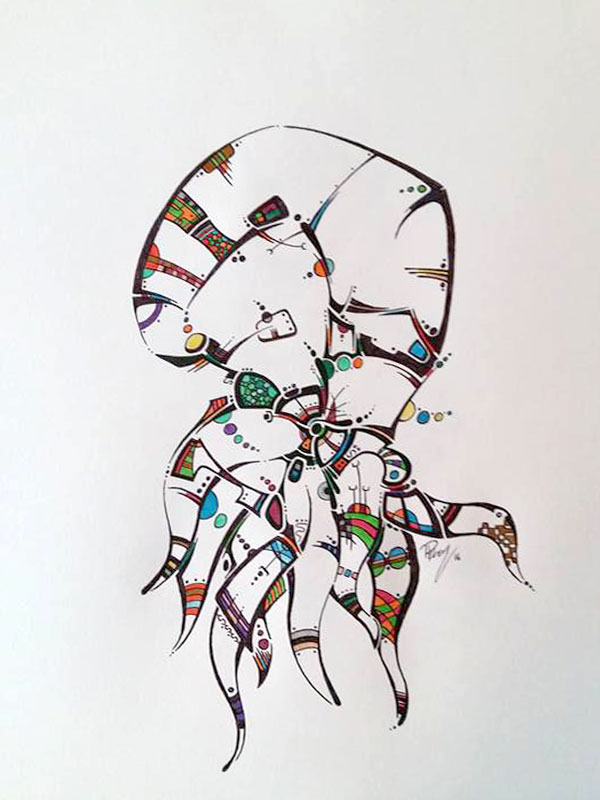
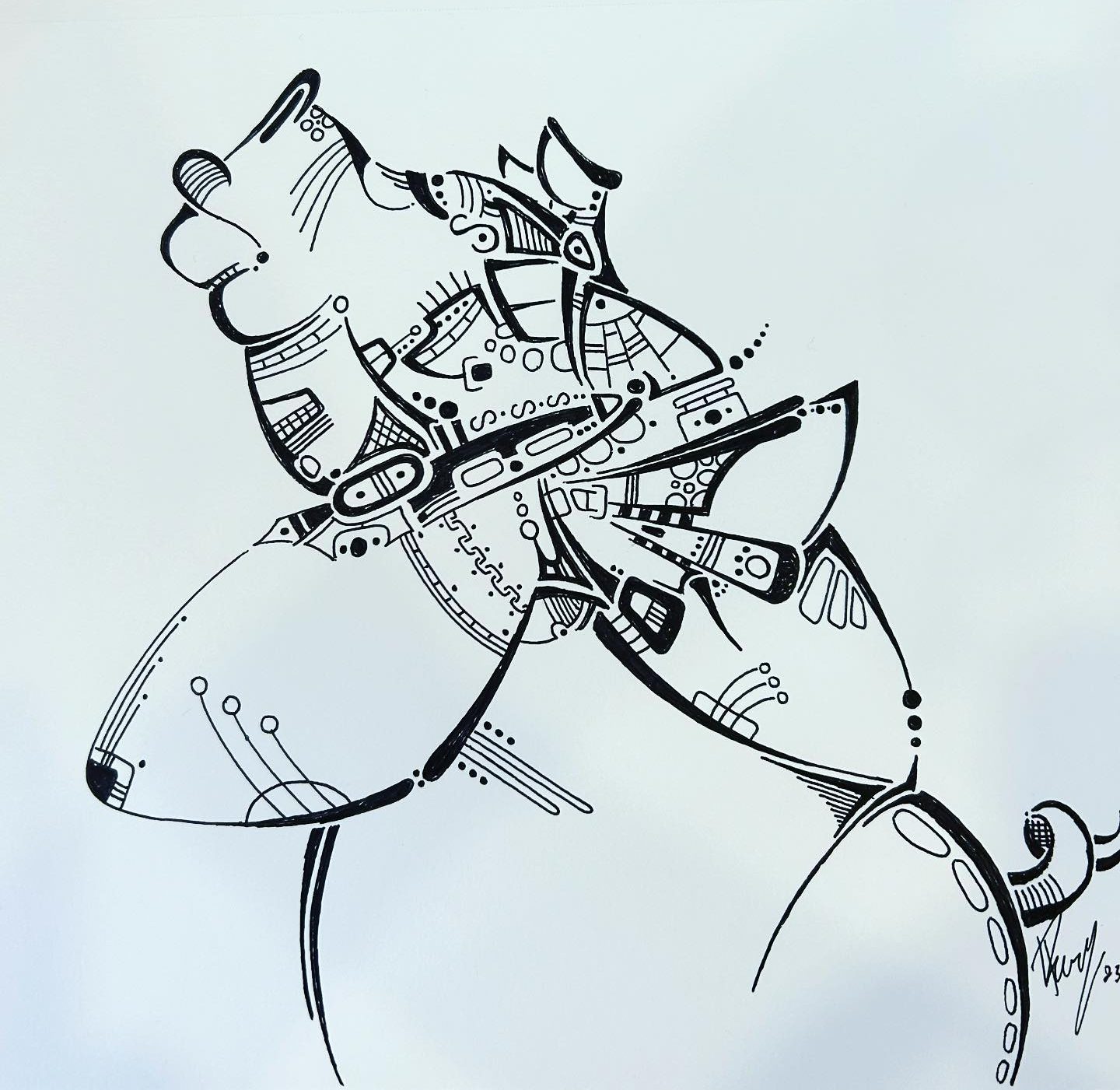
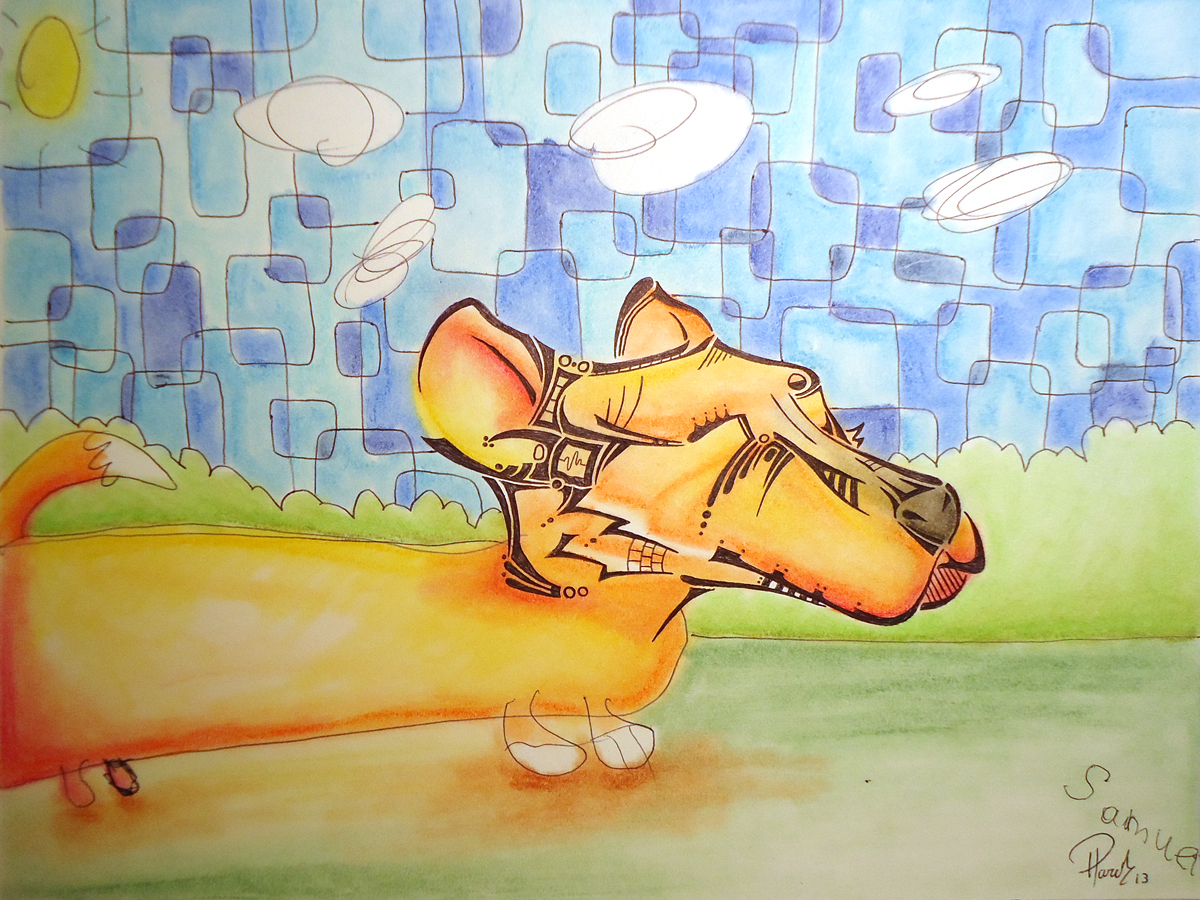



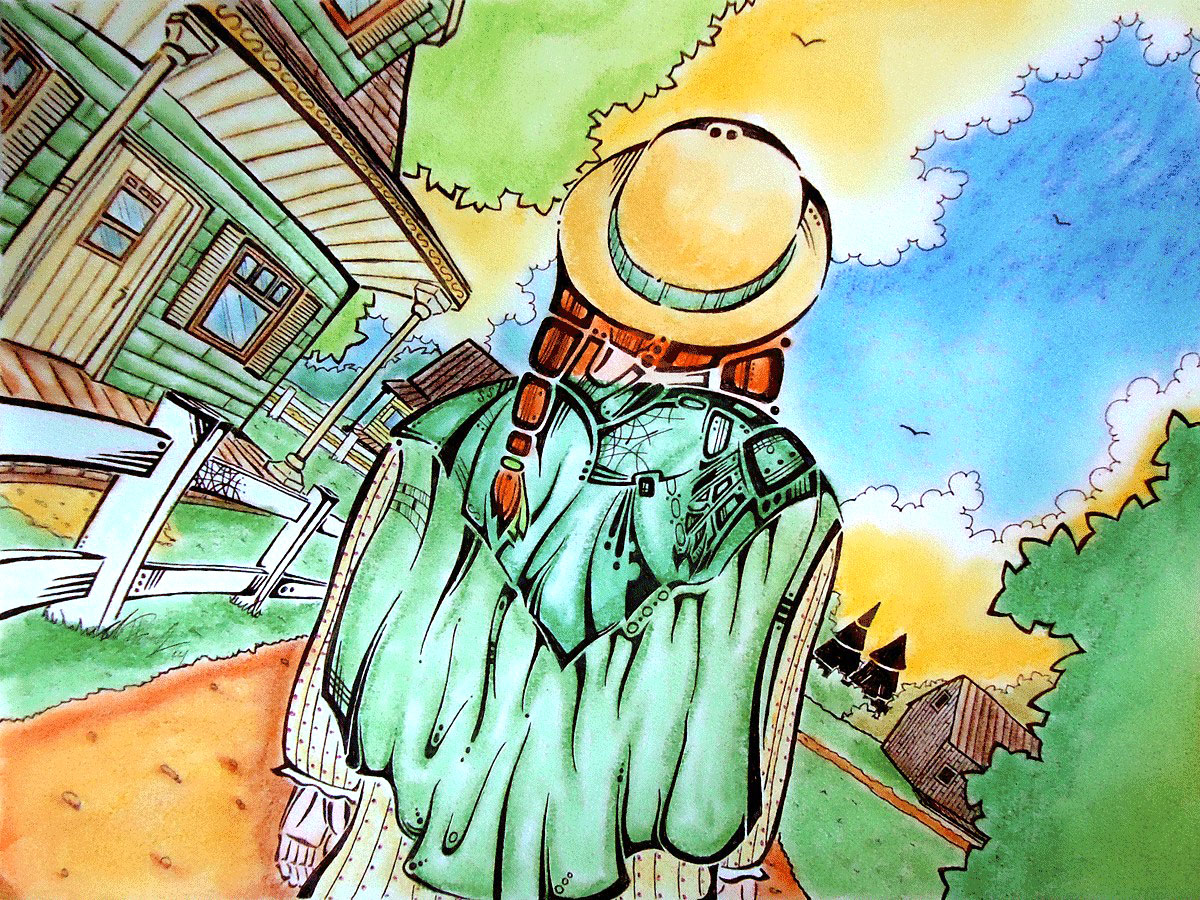
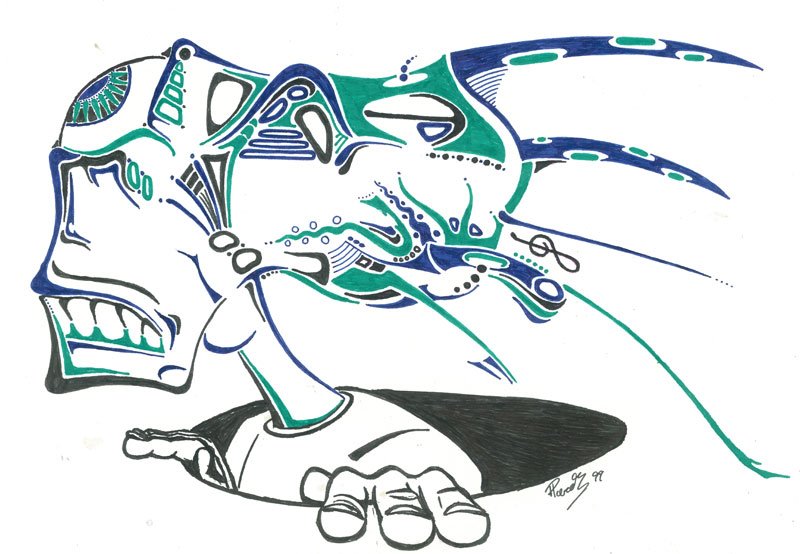
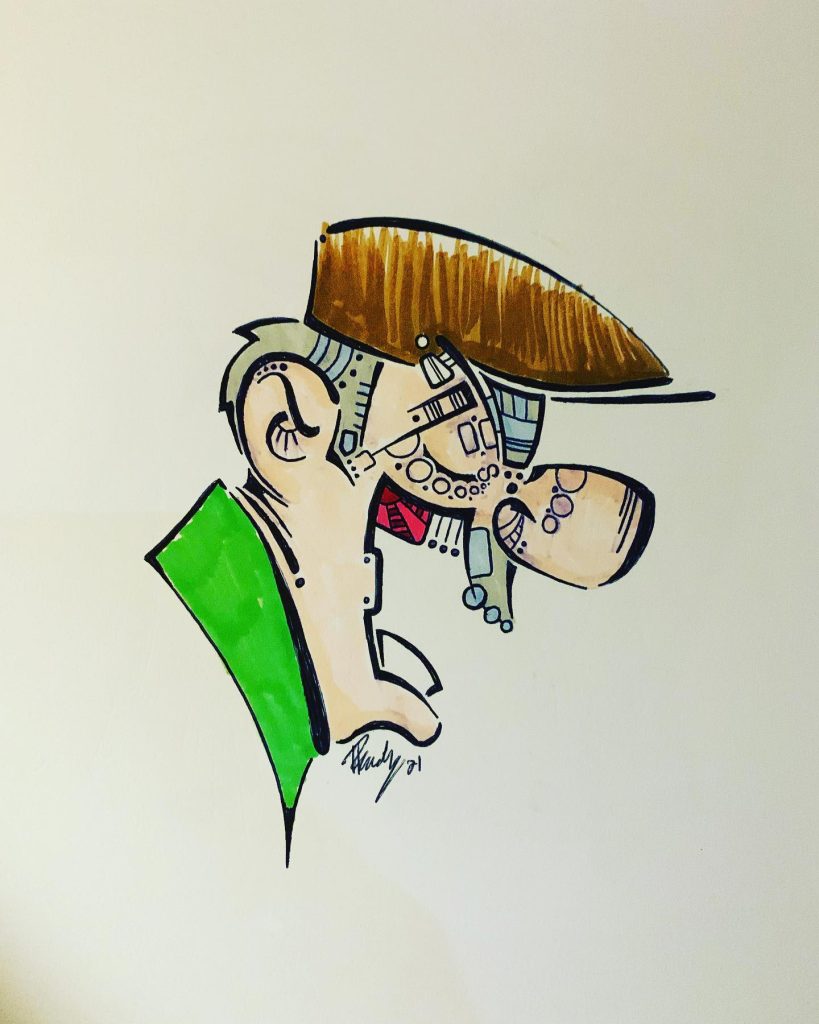
In Old Man, Patrick Hardy delivers a slyly arresting portrait that sits somewhere between caricature, cyborg schematic, and psychological study. Rendered in ink and felt pen, the work stages a profile view of its subject—a man whose exaggerated features and hybridized anatomy resist nostalgia and instead lean unapologetically into the present tense.
At first glance, the figure reads as playful: the bulbous nose, the flattened cap of ochre hair, the sharp green triangle of a jacket collar. But the longer one looks, the more the drawing reveals itself as a meditation on aging in an increasingly mechanized world. The man’s face is dissected by a lattice of lines, dots, and panels that evoke circuitry, prosthetics, or industrial design. These graphic interruptions feel less like wounds than augmentations, as though experience itself has etched a technical diagram onto the skin.
Hardy’s line work is confident and economical. Black ink establishes a bold, almost cartoonish silhouette, while the felt pen fills—muted flesh tones, acidic green, rusted browns—add warmth without softening the image’s edge. The choice of felt pen is especially telling: its flat, even saturation reinforces the graphic clarity of the composition, aligning the piece with illustration and comics while still firmly inhabiting the space of contemporary drawing.
The expression of the subject is ambiguous, hovering between fatigue and stoicism. The slightly open mouth suggests speech interrupted—or perhaps a sigh mid-exhale. This is not an idealized elder, nor a sentimental one. Instead, Old Man proposes aging as accumulation: of memories, of repairs, of internal systems no longer hidden. The face becomes a map of lived complexity rather than decline.
What gives the work its quiet power is its refusal to explain itself fully. Is the figure literally mechanical, or is the machinery metaphorical? Is this a portrait of a specific individual, or an archetype? Hardy leaves these questions unresolved, trusting the visual language to do the work. In doing so, Old Man feels both intimate and universal—a compact, incisive drawing that uses humor and stylization to arrive at something unexpectedly humane.
In a cultural moment saturated with hyperrealism and digital polish, Hardy’s ink-and-felt-pen approach feels refreshingly direct. Old Man reminds us that a few decisive lines, placed with intention, can still carry a surprising emotional and conceptual charge.