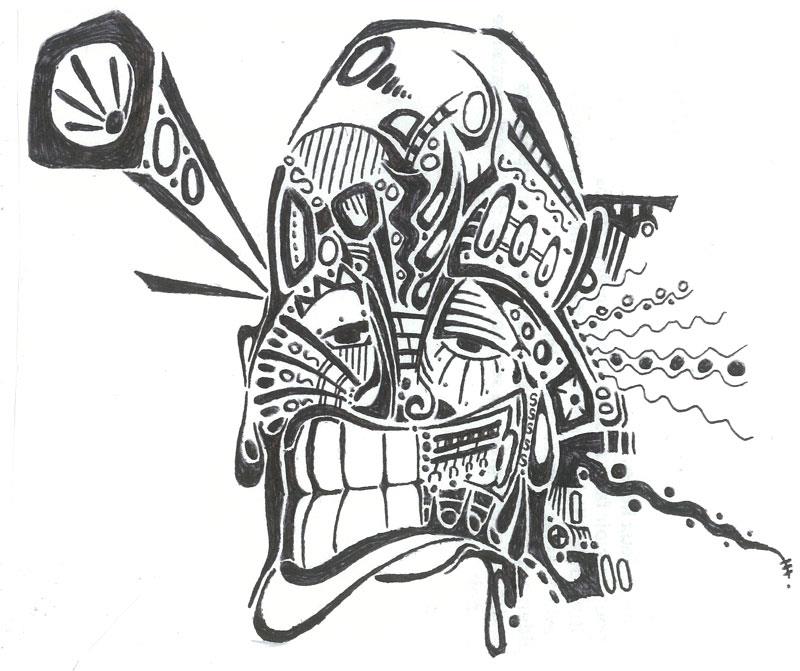
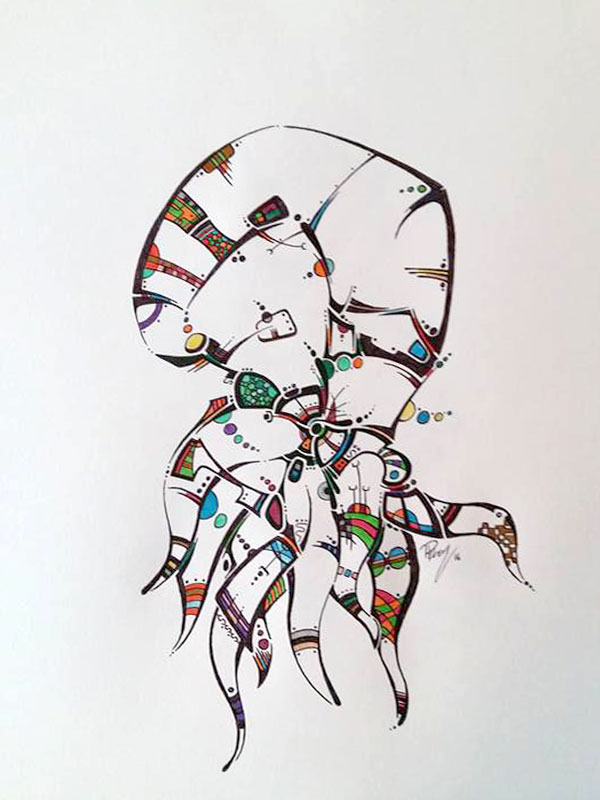
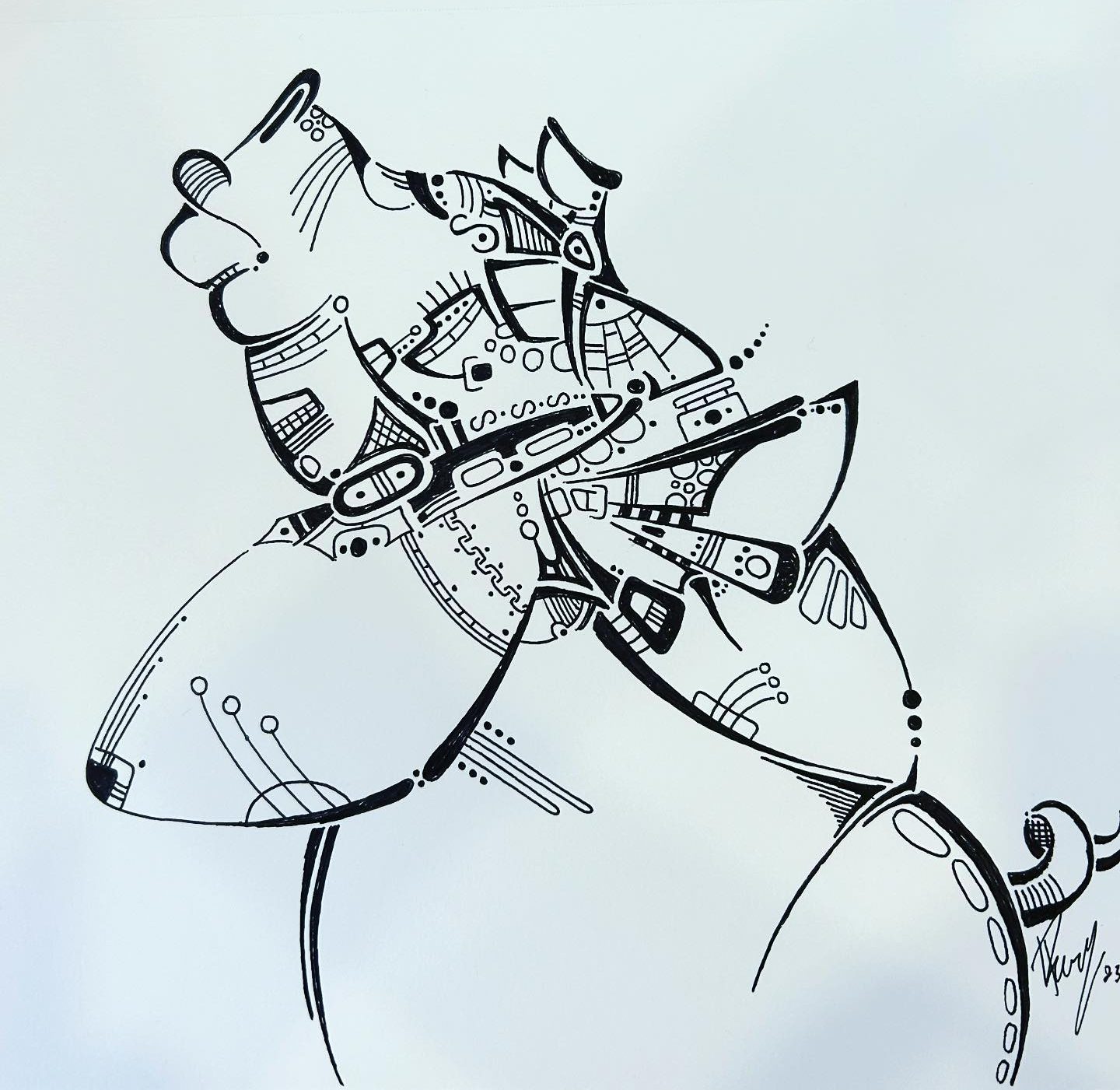
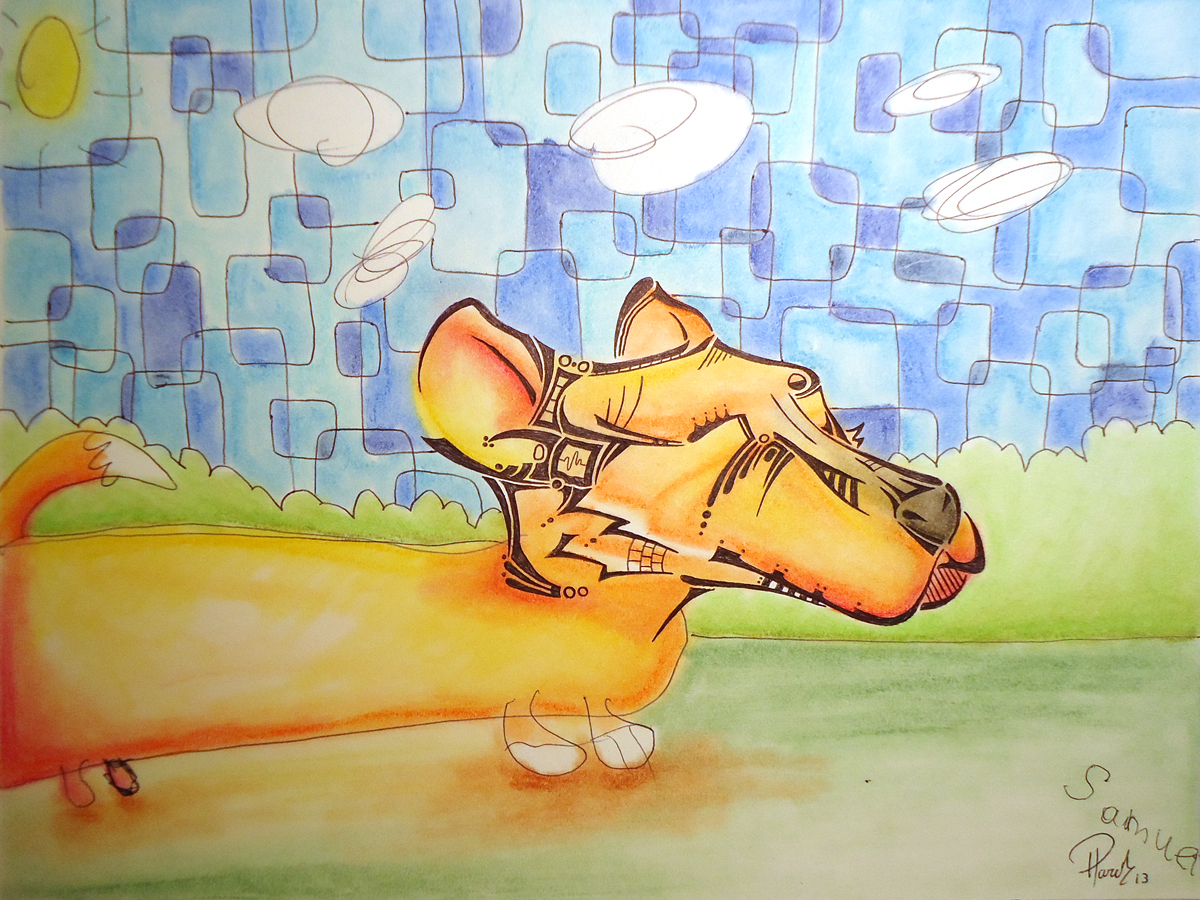
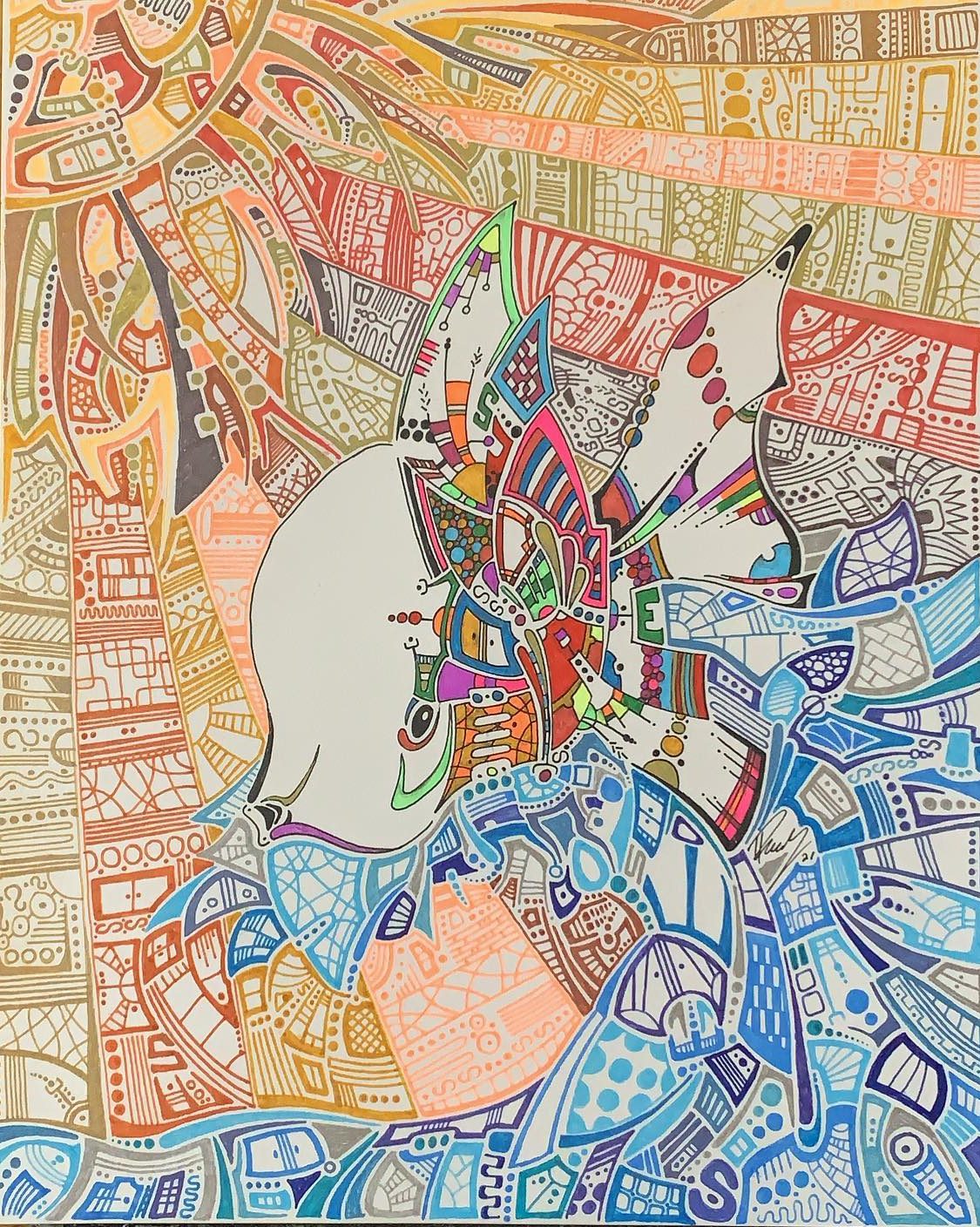
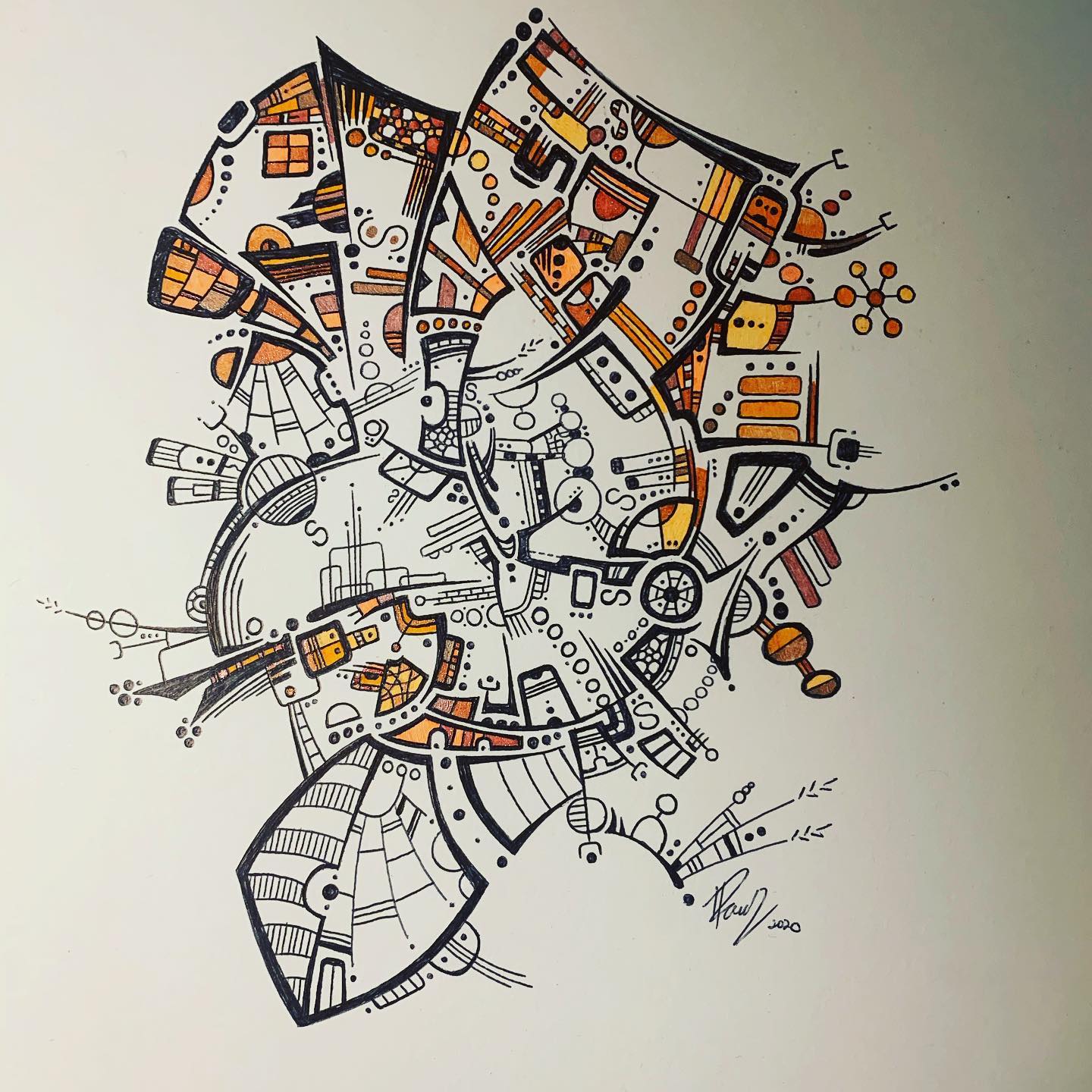
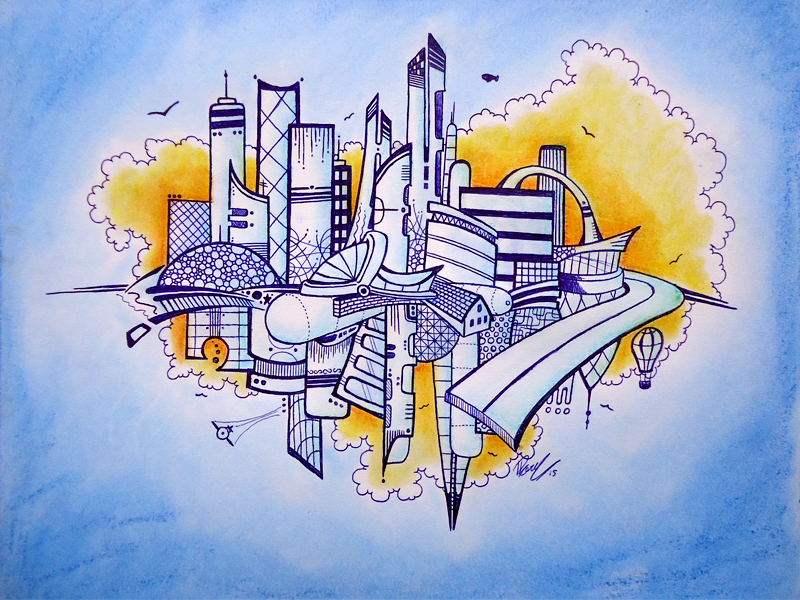
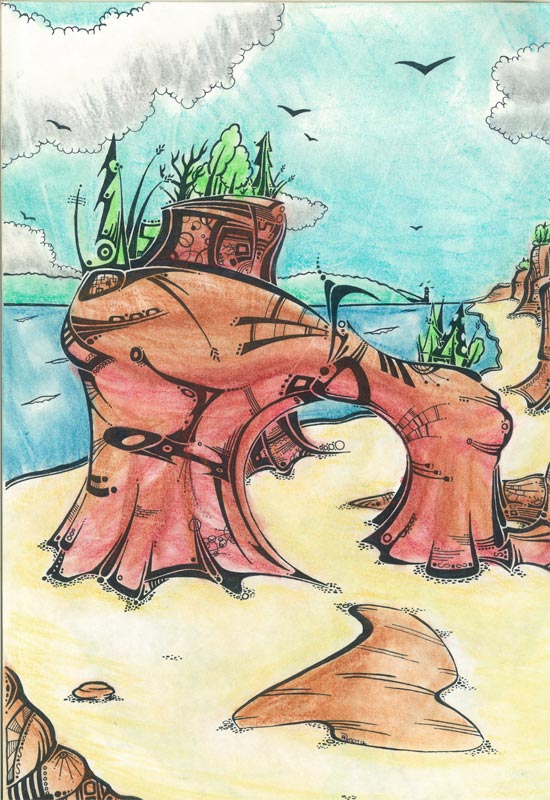


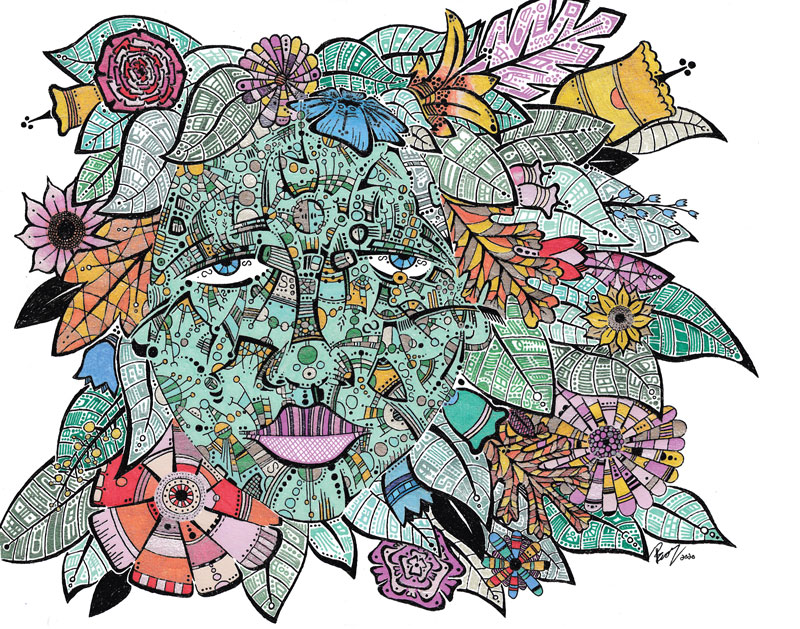

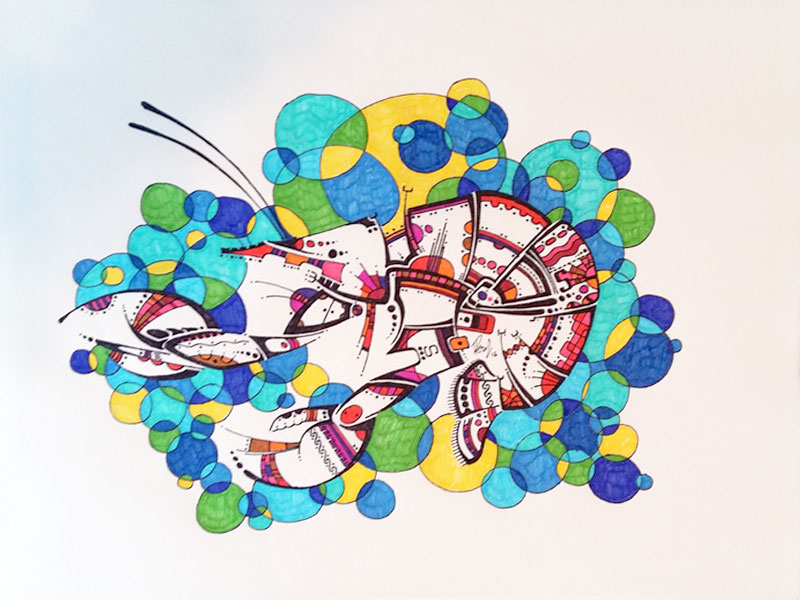
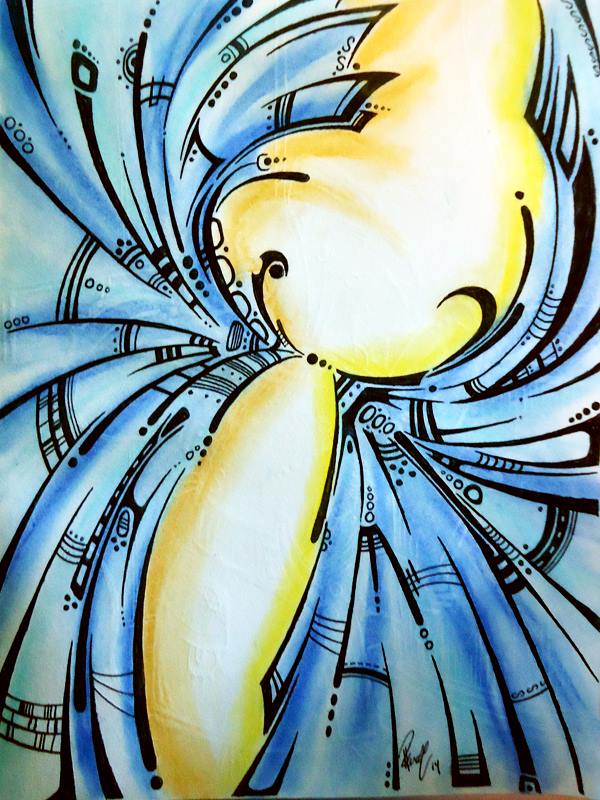
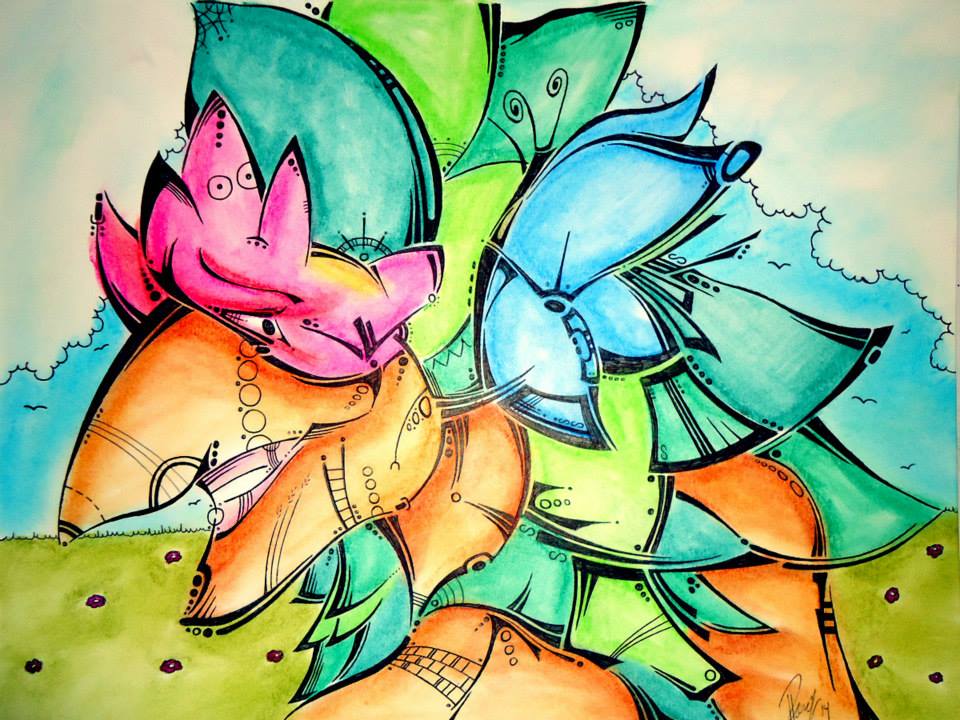
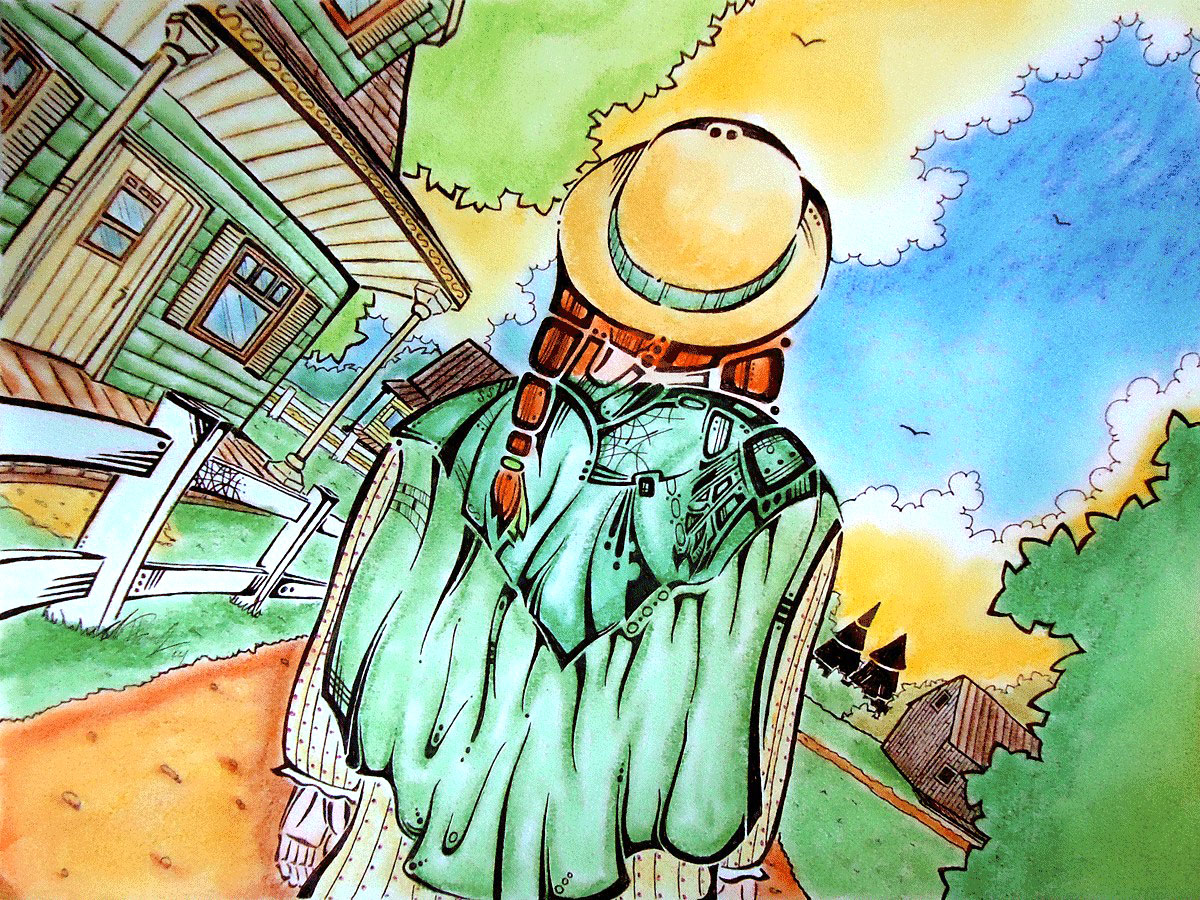
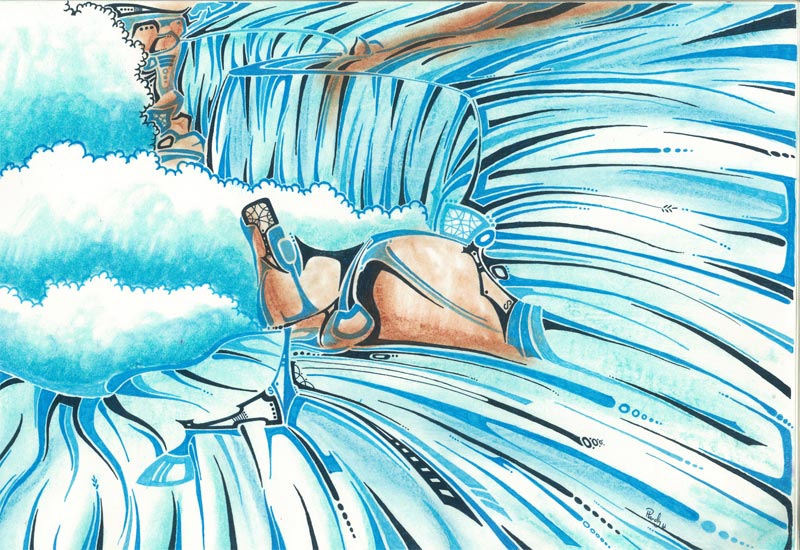
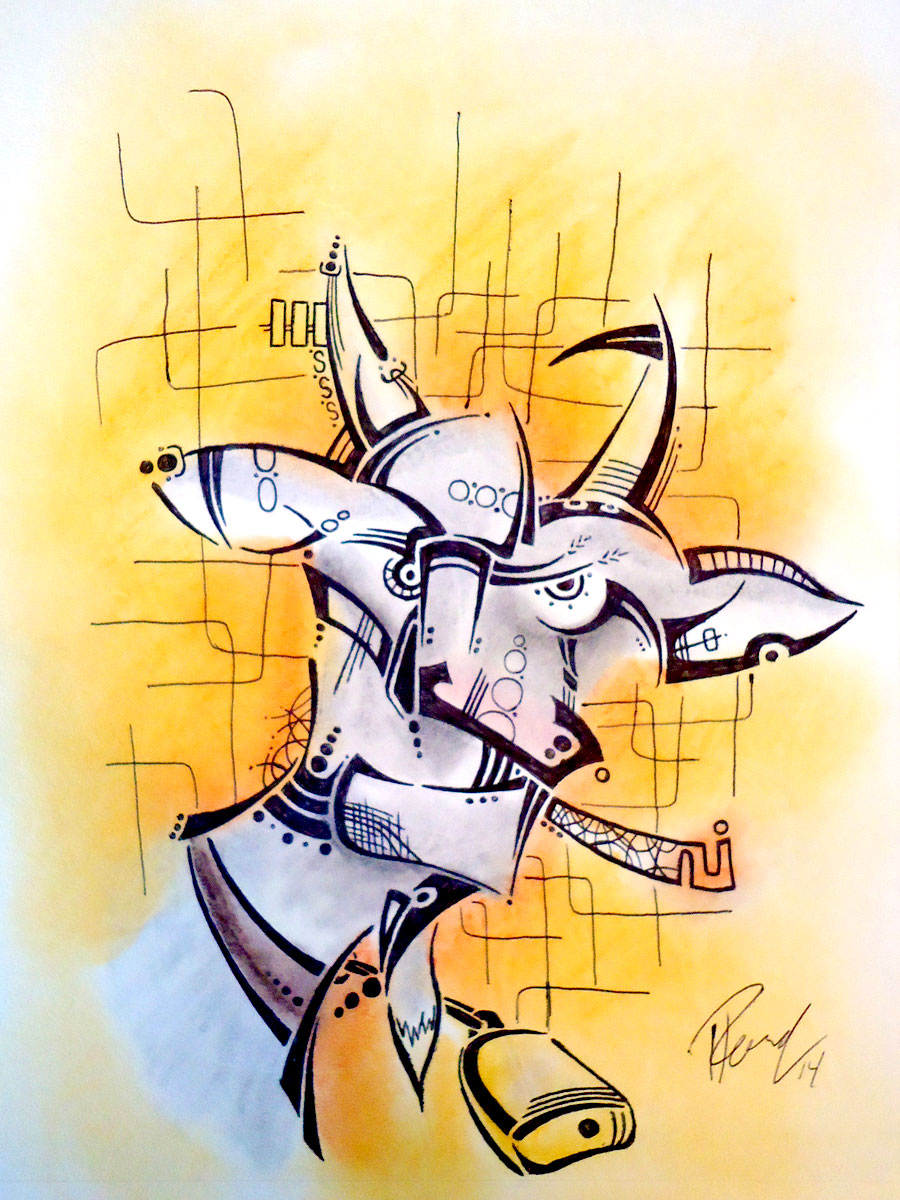
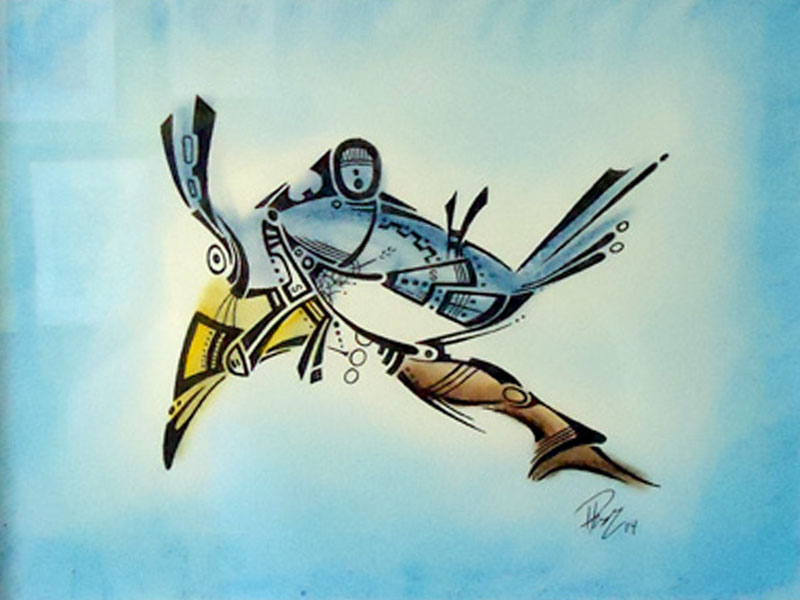
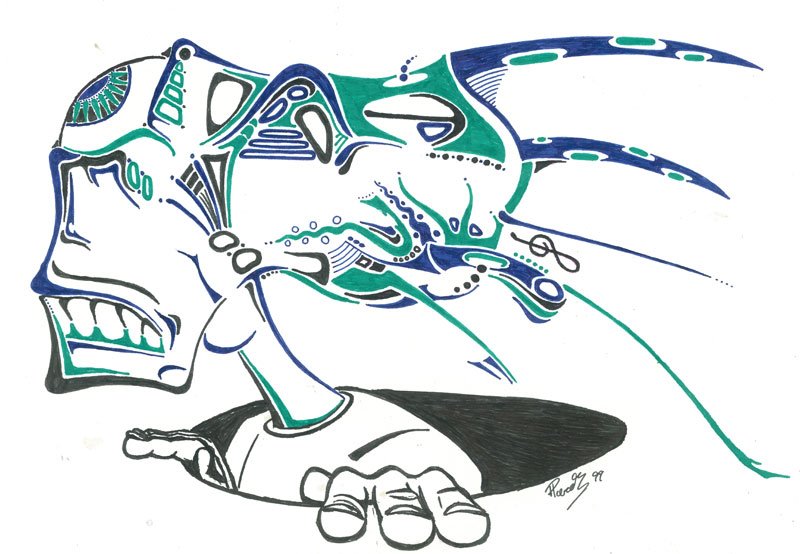
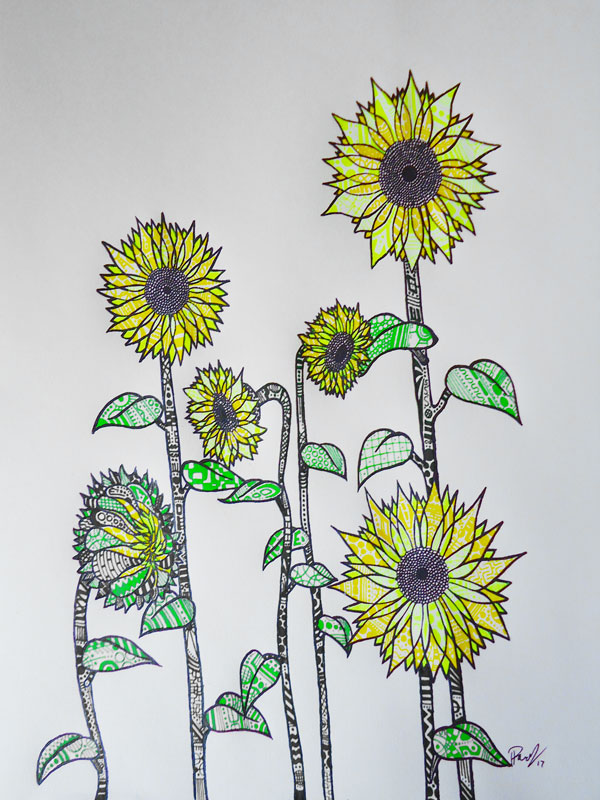
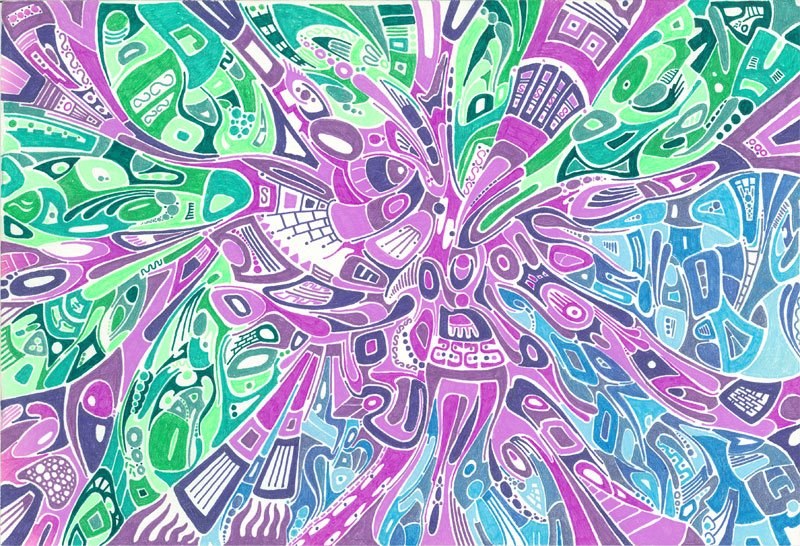
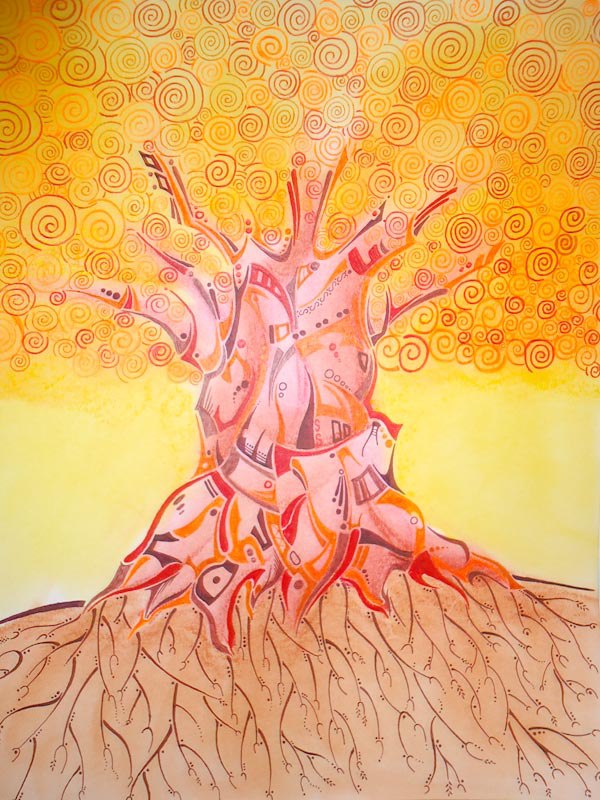
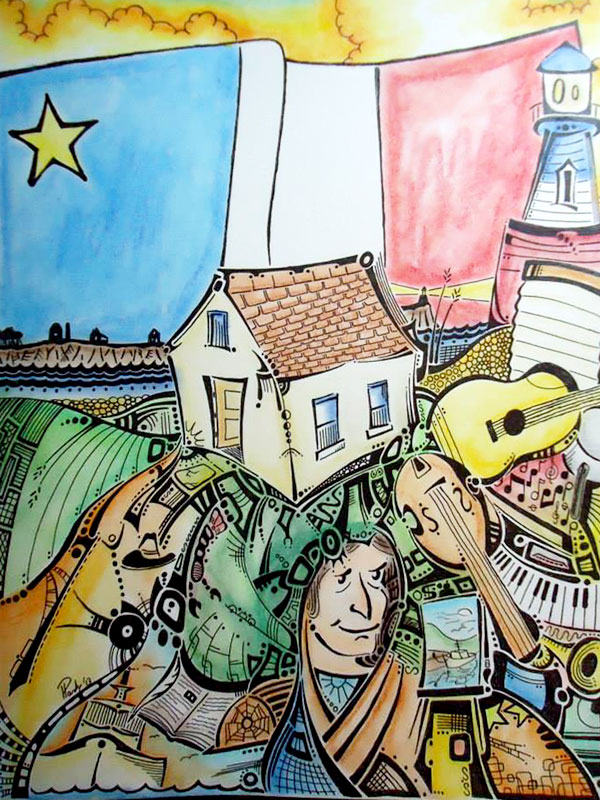
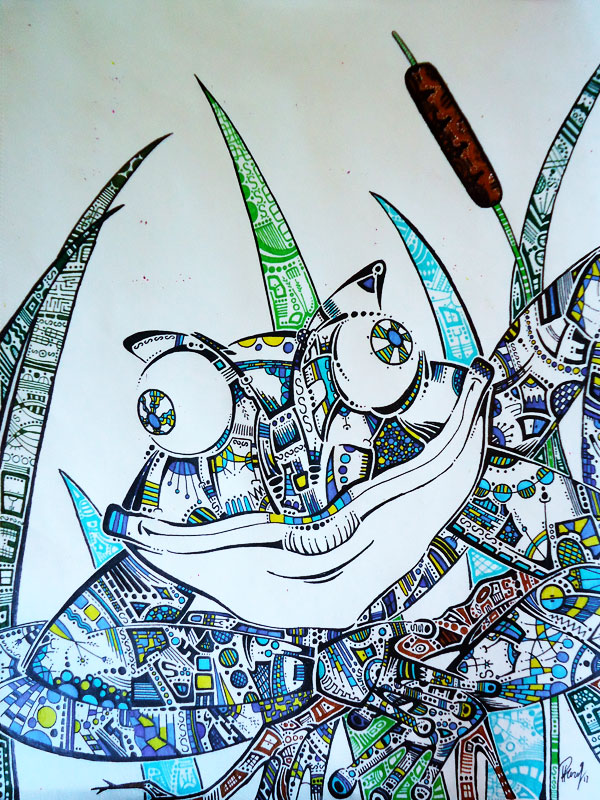
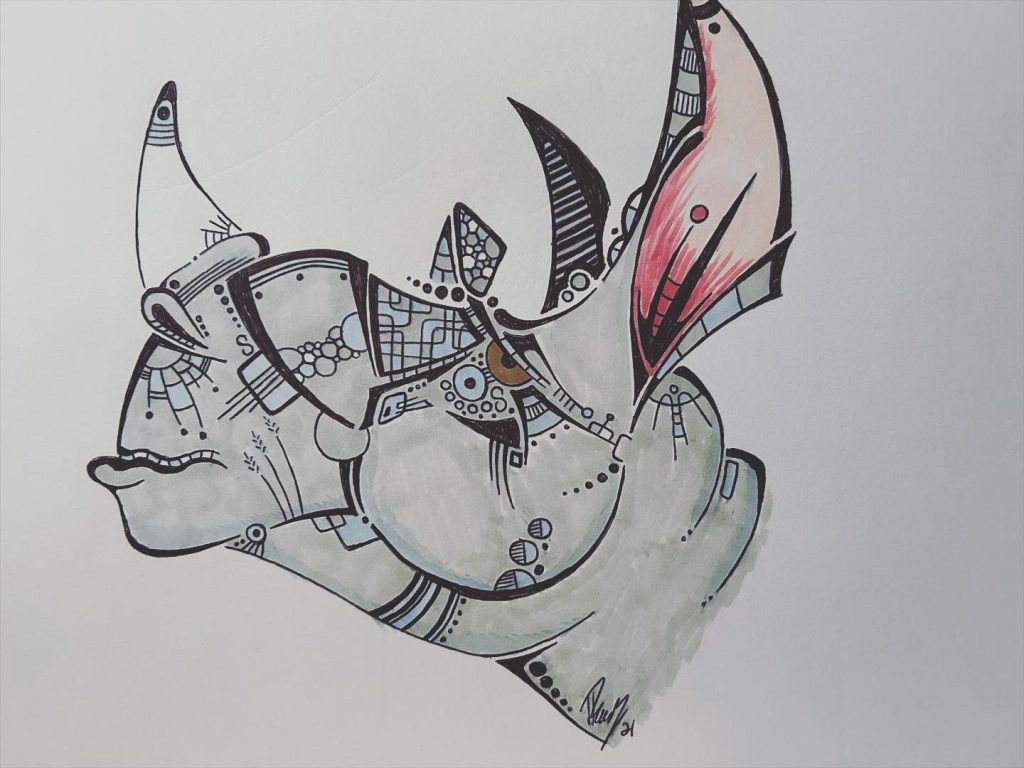
In this work, Patrick Hardy shifts from vertical monumentality to a more intimate, horizontal flow, presenting a form that feels less like architecture and more like a living body in motion. The drawing unfolds as a hybrid organism—part creature, part mechanism—its contours fluid, its interior alive with patterned systems and symbolic markings. Rather than standing upright like a totem, this form seems to drift, rest, or glide, inviting a slower, more contemplative engagement.
The composition is defined by curvature. Soft arcs and rounded masses dominate the silhouette, giving the piece a sense of buoyancy and breath. These sweeping forms are counterbalanced by Hardy’s precise linework: grids, dots, bands, and cellular textures that articulate an internal logic. The contrast between the organic exterior and the engineered interior creates a compelling tension, as though the figure is both grown and assembled, natural and constructed.
Color is used with restraint and sensitivity. Muted greens, pale blues, and gentle washes of gray establish a calm, almost aquatic atmosphere, while a striking accent of red-pink introduces a visceral note—suggestive of muscle, vulnerability, or inner life. This restrained palette allows the viewer to focus on structure and rhythm, while the subtle transparency of the washes gives the impression that the form is permeable, layered, and in flux.
Hardy’s visual language once again draws from systems of mapping and notation, but here it feels more personal, almost anatomical. Certain shapes recall organs, fins, or protective shells, while others resemble circuitry or armor. The piece occupies a liminal space between creature and diagram, suggesting a being that has evolved in response to both environmental and technological pressures. It is not clear whether this form is ancient or futuristic, but it carries the quiet authority of something that has adapted and endured.
Negative space plays a crucial role in this work. The expansive white background does not merely frame the figure; it gives it room to breathe, reinforcing a sense of isolation or suspension. The figure appears unmoored, as if floating in an undefined environment, heightening its ambiguity and emotional resonance. This openness encourages projection: the viewer is free to imagine the context in which this being exists.
Conceptually, the drawing suggests themes of hybridity, resilience, and inner complexity. Unlike overtly expressive abstraction, Hardy’s approach is measured and introspective. Meaning emerges gradually through repetition, pattern, and subtle variation. The work does not demand interpretation; it invites it. One feels less like a viewer and more like an observer encountering an unfamiliar lifeform—quietly studying its surface in hopes of understanding its inner workings.
Ultimately, this piece exemplifies Hardy’s ability to merge control with intuition. It is meticulous without being rigid, expressive without becoming chaotic. The drawing stands as a meditation on form, adaptation, and the delicate balance between softness and structure. In this imagined anatomy, Hardy offers not a definitive statement, but a space for contemplation—an organism that exists somewhere between the known and the invented.